Showing posts with label #Write4Girls. Show all posts

Saturday, April 25, 2015

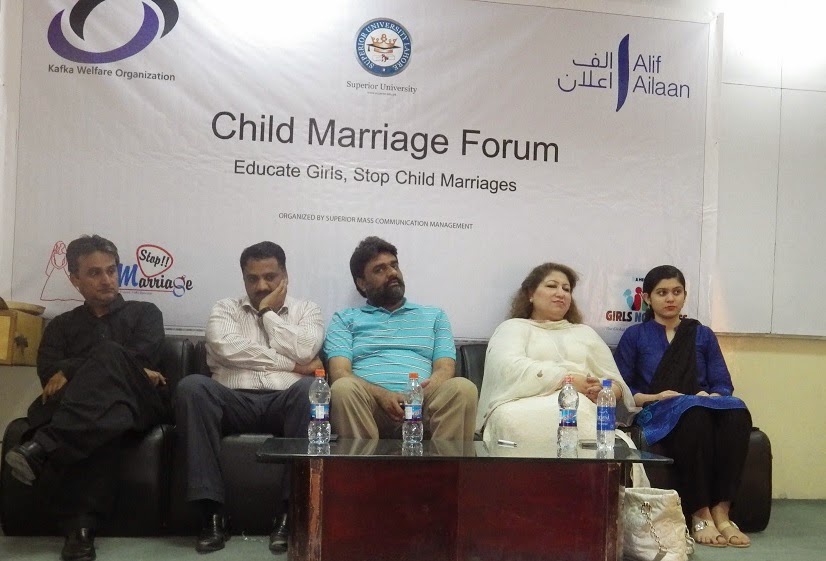
Educate Girls, End Child Marriages


A Child Marriage forum was organized by Kafka Welfare Organization in collaboration with Alif Ailaan at local university with development communication students and civil society representatives under the child marriages campaign of Kafka Welfare Organization. The theme of forum was education girls, end child marriages. In the forum Ms. Sadia Sohail Rana MPA PTI, Mr. Salman Abid Regional Director SPO, Mr. Irfan Mufti Director SAP Pakistan, Mr. Sohail Riaz Director Superior University and Mr. Ahmed Sheikh Senior Journalist Participated as a speaker.
Government and Parents should make girls education a priority to end child marriages, without making it a priority we cannot change our future said by PTI MPA Sadia Sohail Rana. Child Marriages are majorly affecting the education of young girls, I am giving my full efforts in Punjab assembly to pass new bill on child marriages. In the current status, we are still hang on minimum age of young girls for marriage.
Mental Maturity and education is necessary for girls to get married as they are going to build next generation. Media should play a different role on such issues, education and issues like child marriages are still not a priority of our media. They are spreading intolerance in the society which is spreading negativity said by Mr. Salman Abid Regional Director SPO.
We cannot educate a nation without educating girls which are our future mothers Said by Mr. Irfan Mufti SAP Director.
We need to implement laws without implementing laws formation has no use. 37% of Pakistani women get married before the age of 18 in Pakistan. It is more visible in backward areas. Studies have revealed a direct correlation between early marriages and low levels of education.
In 2012 and 2013, 53.7% of married girls between the ages of 15 and 19 years never went to school, highlighted by Mr. Umair Asif (Alif Ailaan)


Sunday, March 1, 2015

Combating HIV/AIDS, Malaria, and other diseases

HIV is a virus which destroys human immune system. In the early phases of disease, the individual has no indications. Be that as it may, as the disease advances, the invulnerable framework gets to be weaker. HIV is transmitted through unprotected sex, transfusion of not contaminated blood, sharing of needles and between a mother and her new born child amid pregnancy and labor. A large portion of the Africans are victims of HIV.

Malaria is brought on by a parasite called Plasm-odium, which is transmitted through the bites of contaminated mosquitoes. In our body, the parasites reproduce in the liver, and afterward contaminate our body cells. If not treated, fever can rapidly get to be life-undermining by disturbing the blood supply to organs. Dengue Virus resulted in numerous deaths in Pakistan.

Malaria and HIV and different sicknesses result in more than two million deaths per year.
In territories with malaria transmission, HIV expands the danger of malaria and fever in grown-ups.

HIV effected pregnant ladies who get to be malaria victims are at expanded danger of all the unfavorable results of malaria in their pregnancy.

• Almost 600 youngsters passed on each day of AIDS-related causes in 2012.


• Malaria intercessions spared the lives of three million adolescent kids somewhere around 2000 and 2012.

Mrs Shehnaaz from Islamabad is victim of AIDS who lives with 6 kids under her care: 3 young girls and 3 young boys around 1 and 13 years. She lost her spouse to the illness and is required to address her own particular needs and additionally those of the children she resides with. Individuals like Shehnaaz inspired Labor solidarity association to begin a system of HIV/AIDS Prevention and Mitigation. The association through this system has backed defenseless family units through their effective seminars.

Prevention of mother and Child transmission of HIV: A Pregnant HIV lady takes medicines in pregnancy and labor to combat the danger of passing HIV to their infants. Their new conceived infants additionally get HIV medication for 6 weeks after conception. The HIV medication diminishes the danger of disease from HIV that may have entered a child's body during labor.

•Needle Exchange: Always utilize new, unused needles or by flushing the needle and plunger with water each one time you utilize a medication syringe.

•Getting Tested: The best way to make sure of your HIV status is to get tested. With oral test, you can even get a cheek swab and get your results in 20 minutes.

•Get Lotions and Safety Nets: To battle Malaria it is imperative to utilize nets and creams which don't permit mosquitoes to draw close to you and don't let any water stand adjacent your spots especially after Rain.

To conclude it’s on us to take best care of ourselves and avoid everything which is prone to these diseases as if we do self-safety and get careful with every step these diseases can never come near us.

By Mishaal Shahzad
Islamabad
Pakistan

Nigeria’s Broken Children

Do you know that Nigeria has an internally displaced population of 3.3million? And most of these displaced people are women and children? As things are, these 3.3 million people are only the officially registered internally displaced persons and many other unregistered internally displaced persons may exist. About 850,000 people in Nigeria’s North East region are internally displaced and the National Emergency Management Agency has set up only 23 camps to cater for them. What this means is that this agency expects an average of about 36,956 people to live in any one of these 23 camps which are mostly National Youth Service Corp camps or secondary schools that do not have the facilities to deal with such a population.
Sometimes, I wonder what it means to be displaced. What it means to abandon your home, to run from the certainty of all that is familiar into the uncertainty of mountains and bushes. In all my questing, I have asked a few people; what that all important thing they will take is: when they hear bombs in distance and the sound of gunfire approach, what is that one thing they take as they leave, of all the people I have asked, two variables kept recurring; certificates and cash. A few people said things like iPads and travel documents, but those were really few.
In justification of the choice of their certificates, most people say that when the insurgents eventually are conquered and there is relative security, only their certificates will help them rebuild their lives. Considering that, since the civil war in 1960, at no point have Nigerians been forced to leave their houses such as now; and when there is a constant threat of death education mostly becomes secondary, it is encouraging that people still believe in the capacity of education to get them out of hopelessness and into opportunity.
In all of these, children are perhaps the worst hit as they are most times pulled from schools and develop an unwillingness to return to education. It is not hard to imagine why. The insurgents who terrorize them serve to fight and banish Western education, the psychological effects of this is in time schools begin to remind these children of horror,  death and bombs.
Perhaps to alleviate this, in addition to clothing and food drives we carry out for displaced persons, we should provide these camps with teachers and mentors. With guides and matrons, because when you live in such atrocious circumstances, there is the tendency that your world becomes small; reduced from beauty and possibilities to the sound of shelling and gunshots.
This by itself is a tragedy we must never allow to happen , we must raise structures that empower Internally Displace Persons (IDPs) to change their mindsets from those of victims to survivors. As it is, we are doing dangerously little to help child victims and it is only our help that can help them win the war against the very same insurgents who made them leave their homes and schools in the first place. Doing anything less will amount to the insurgents winning and the children loosing.
Most people argue that from the United States to Kenya and Pakistan or France, Nigeria is not the only country battling insurgency either on its shores or in an ally nation. The thing with the Nigerian state is that we lack the capacities these nations have demonstrated in dealing with these insurgencies and even when we make progress in infrastructure or the economy, lives don’t improve because the basic necessity of security is not provided.
On one of the only times I met a displaced child; I asked her the kind of questions you expect a concerned older person to ask. I asked her ‘What do you want to be when you grow up?’. I half expected to hear ‘doctor’ or ‘pilot’ or ‘hair dresser’, but no. Her face turned blank and she said “Alive. I want to be alive when I grow up.” I did not ask any more questions. The tragedy that the Nigerian state has become hit me.

 By Adejoh Idoko Momoh.
Sunday, January 4, 2015

You

Are the worst enemy I
will ever face. You
are that man of different
creed or race. You

Am I that different?
Do my eyes disconcert

You? Why you?
You killed her! It was

YOU! Get back here and pay for your sins!
We may lose the battle but you will never win!

You killed her!
You raped me!
You stole my life!
You broke my things!

We will fight, and fight, and fight once more, without any knowledge of what tomorrow brings.
Peace
Is now the caged canary that sings
Set down your guns, open the cage
Watch the bird wash away the rage.

By
Zara Williams-Nicholas

Peacock


Have you ever thought to yourself having only one leg but also being happy and dancing like a peacock is possible? You may call me insane but it's not a foolish question that I am asking as I have seen someone really doing it here in Nepal. Neelam Dhungana, 21, an amputee, who lost her one leg in a tragic bus accident while she was only 15, has the power to dazzle you with her mesmerizing dance performance. I bet, you will start imagining yourself in her shoes and feel miserable for having both legs and still not being able to have those flawless steps like her. Neelam is an exemplar in this mentally handicapped society where, physical disability is associated with failure, with dependency and with not being able to do things (even the regular chores of life).


Neelam as her name suggests, is really like a gem stone (The Blue Sapphire), with a captivating beauty and never ending smile. Her school mates always had a dream of dancing like her as every one used to appreciate her dance moves. Any cultural program at school and Neelam wasn't there; the program wouldn't be interesting, and theywould opine. She was synonymous to a peacock.

Our life is like a Pandora's Box. We never know what tragic surprises it has for us when we open it. The same happened with Neelam when she was just on the edge of her youth. An ambitious dream of being a famous actor, a blissful teenager, thousand youthful aspirations and most of all the best diversion of her life; dancing were all shattered in a road mishap made by a careful driver when she was rightfully walking on her own lane holding the hands of her best buddy. In the tragedy she not only had to lose her friend forever but she even had to mislay all her dreams and lead her remaining life as an amputee with only one leg. When she remembers the very day she says, "I learnt that my leg was amputated only a day after. Though my family members were around me giving me hope, but in private I used to admit the misery and shed tears for the misfortune of not being able to dance any more.

Yes, there is light at the end of the tunnel. For her, disability was typical trajectory. After a period of time, she started to adapt to her new situation, and started making much of it. She started dancing even with her one leg without giving notice to others for her happiness as dancing was the ultimate ecstasy of her life. After five years of practice (which wasn't easy), her talent got the limelight on a local stage on the occasion of 'International Day of Persons with Disabilities' a year back with the support of Bhima Khatiwada and Mina Acharya, who too are physically disable; whom Neelam likes to credit. Since then, she has never stepped back from her aspiration of being an actor. "Even if life is sometimes hard, my spouse, parents and mentors have always supported me and helped me become the one-leg dancer of Nepal.", Neelam shares.

We often assume that people with disabilities are unhappy. But in fact we're wrong. Surveys reveal people with disabilities consistently report a quality life as good as, or sometimes even better than that of non-disabled people. Human flourishing is possible even if you lack a major sense like sight, ability to walk, or beingphysically dependent on others. Sometimes, disabled are driven to greater achievements than before. That's why if we presuppose that physical difficulties for people result in misery for them, then we are wrong.

What is more important here is the social blockade rather than the physical impairment itself. It's true that in general, disabled people usually have fewer choices than non-disabled people. Most societies still have limited accessibility for them, which have certainly created some problem for them. Otherwise, special people like Neelam are much better than mentally jammed people of our society.


Yes, it's also true that physical impairment undoubtedly involves greater degrees of misery than average human should endure. Apart from that, there are some examples like Neelam whose transformative life stories teach us an important lesson that human beings are capable of adapting to almost any situation and can march on to triumph, overcoming all the misfortunes. Neelam, even after such misfortune still dances like a peacock.

Written by: Bhawana Shrestha
Country: Nepal

Write 4 Girls

The door slammed. It was a sign for young Diwa to start trembling and shaking. At that point, she was stuck in a dead - end street, not knowing what to do. Suddenly, a husky, dark - haired fellow cast a shadow on the wall; while entering the room. Diwa, now petrified, started praying. From that moment on, everything for her was a blur...except for the bruises on her entire body.

Do you happen to feel the chill running down your spine while reading this? You should, because it is alarming and to be quite upfront, not so frequent. You may not pay much attention, but many other girls in our surroundings crave to be salvaged from the claws of people who own them. Unfortunately, even though we live in the 21st century, that phenomenon is still among us. Those girls are thrown away on the street, made robots for distributing money at an early age. It does not seem or feel right. But the question remains - What should be done?

Girls are often considered as a weaker gender, being put in inferior position. But shouldn't they be treated with care and protected? I bet you can see the irony in that. Imagine your sister, cousin being abused and maltreated by a bully or, if we stretch to extremes, a pimp. You would do anything to change the situation, regardless of the law and regulations. That is how we need to start feeling for all the girls, not just the significant ones. In this theoretically free world, people are open - minded and ready to help by giving tribute to those who deserve. Girls are awarded Nobel Prize because they deserve it, by showing how strong and independent the weak gender can be. That is something I personally, feel proud of. Neglecting the nation she belongs, ethnicity and religion. That does not matter when we have a higher purpose, a goal to chase.

As for Diwa, we need to pray her word gets heard, that she finds her Safe Heaven, her shelter in this harsh world. Hope is something we need to embrace and to cherish, without which we cannot survive. Hope is the one thing that keeps us going. Hope for a better future, for a better life with love, equality and peace. That is what we all long for, is it not?

By

Una Ristic

Issues faced by Young Girls and Women Empowerment


Gender Inequality basically refers to unequal treatment based on sexual orientation. It emerges from differences in socially developed gender roles and additionally organically through hormonal differences. Gender frameworks are regularly hierarchical; gender twofold frameworks may reflect the disparities that show in various measurements of everyday life. Gender Inequality disparity comes from discrepancy, whether experimentally grounded or socially built.

In every aspect of society, gender inequality balance has turned into the norm. All around acknowledged standards of human rights have set the standard for correspondence between women and men. This concept reaches out to the distinguishment that young girls and women are remarkable individuals with rights and duties like those of young men and boys.

Have you ever pondered the lives of young ladies of your age in poorer nations as far and wide as possible? From numerous points of view they are the same: these young girls enjoy in family, attempt to discover time for hanging out with friends, and consider what's on the horizon. Anyway in a few ways the issues and difficulties confronting them are altogether different.

Twenty-five percent of adolescent young ladies in "developing" or low-salary nations live in extreme poverty. It implies that individuals don't have all the basic needs for survival, in the same way as food, water, lodging, home, clothing, education, and health care. 


In numerous nations, young girls are esteemed far short of young men; they don't have the opportunity to go to class, to long for a future career, or have fun time. Envision what your life would be similar to if your parents thought it didn't make sense for young ladies to go to class, get medical consideration, or even get as much foodstuff as young men.

Education: In numerous countries, when young ladies are near to their puberty, their guardians demoralize them from proceeding in school or even pressurize them to drop out, to protect their reputation and marriage prospects. In Sub-Saharan Africa, for instance, just 17 percent of young girls are enlisted in secondary (high) school.

Training = Power: Every year of educating builds a young lady's earning power by 10 to 20 percent, while the return on their secondary education is significantly higher. Additionally, improved education for young girls is interfaced to lower HIV disease rates, lessened baby mortality, and an increment in a country's general for every capita pay.

Work Opportunities: Young women have a harder time finding work than young men and by and large are considered as just for a restricted range of "suitable" occupations like sewing, housekeeping (household), or factory work. These occupations pay less of what the young men's occupations. Young girls are frequently abused by their managers in light of the fact that they have constrained power, security, protection and rights.

Early Marriage: Young Motherhood, Unwanted Pregnancy, and Disease: One in seven young ladies in creating nations get married before age 15, and almost half are married by age 20; regularly, the young ladies are not given a decision in the matter. Married, young ladies go from fathers and siblings to their spouses. Not just do one-third of ladies in creating nations conceive an offspring before age 20, they are much more prone to pass on from pregnancy-related complications than ladies in age of 20.

Their children are likewise at higher danger of illness and death. Substantial extents of these pregnancies are unwanted, since a large portion of these young women need access to legitimate health awareness and birth control. Every year, somewhere around 2 and 4 million girls resort to risky, off and on again fatal, abortion techniques. 


Young Girls and women in late-modern social orders are depicted as those most subordinated to the consumer society. In previous socialist nations, prostitution has offered restricted to acquire the moneynecessary to take part in new consumer ways of life. All through history, young people have been examined as to their demeanour, conduct, sexuality and general behaviour. Moral Panics are frequently structured in West Society .Ex: Teenage Pregnancy and Crime rate expanded due to growing youthful mother population. In Central and South Asia and sub-Saharan Africa, one in five births is to a female under age 20. The conception rates for youngsters in this age gathering are additionally high in Latin America and the Caribbean and in East Europe compared and rest of Europe as appeared.

The lifestyles and practices of young ladies and women have changed. Smoking and under-age drinking have ended up more normal and become a norm, and drug use has expanded. A British study -In 1995 demonstrated that one in five females between the ages of 14 and 25 utilized cannabis at any rate once a week, and 22 percent of the 15-to 16-year-old young ladies surveyed had attempted it;11 numerous young ladies apparently related drinking and drug use with sociability and development.

Consistently, more than 14 million young ladies wed before their eighteenth birthday. Early marriage is most common in rural and impoverished territories of sub-Saharan Africa and South Asia; however the practice is in no way, shape or form restricted to these regions.

Poverty frequently triggers this practice. Families may trust that an early marriage will secure a young girl's future and honour. Again and again, however, these unions bring about disempowerment, misuse, and early pregnancy – all of which can prompt genuine wellbeing outcomes.

The information is compelling: almost 30% of young ladies matured 15–19 in a marriage or dating relationship have encountered physical and/or sexual violence on account of their intimate partners. Complications joined to pregnancy and labour is the second leading reason for death among these girls.

Early marriage damages a young lady's rights. It adequately closes her Education and her capability to win her living further down in future, helping society's economic and social advancement. It can likewise put her life in danger.


Conclusion 
Girls are needed to be encouraged and backed by other ladies. Occasions bringing ladies and girls together, workshops building self-assurance and respect toward oneself.Displaying persuasive yet aspiring good examples to young ladies who they can look toward and learn from. Raising aspirations of young people and helping them recognise their so they can accomplish positive things in life. We must guarantee equivalent access to education and livelihood opportunities for ladies and young girls. We must challenge social standards that help male power and control over ladies and young girls. We must empower adolescent young ladies with confidence, faith and awareness of various life options. We must work with juvenile young men and young ladies to create equal connections relationship in shared appreciation. We must train parents and schools to teach kids through non-violent practices.

BY
MISHAAL SHAHZAD

Write for Girls

Every young adolescent girl all over the world is being assaulted by society based on her gender, she often gets beaten, raped and in some countries even murdered. It is a huge problem that can cause young girls to feel as if they are not an important part of society and it can destroy their self esteem. I’m sure that every young girl is special in her own unique way and because of that they should be respected and allowed to be who she really is.They are often afraid to talk about that, but when the whole world is silent, even one single voice becomes powerful.
Every girl should have the dignity, respect, education and freedom she deserves. The best way to help young adolescent girls is to unleash their own potential to change the world. God bless those ambitious young adolescent girls who are willing to fight for their rights!

By
Ermina Beganovic